Recordings
Earthly Solace
CRD3569
Whilst the first volume reached for the celestial, Earthly Solace, brings the sublime polyphony of the late 15th century back to the soil of human experience, breathing life into works that have remained silent for over 500 years – casualties of time and the Reformation’s upheaval. Five of the nine tracks are world-premiere recordings of reconstructions by Dr Russell Blacker. The album’s title and emotional core are drawn from two rare, complete survivals within the Eton Choirbooks: Banester’s ‘O Maria et Elizabeth’ and Browne’s ‘Stabat Iuxta Christi Crucem’. These works ‘bookend’ the tragic life of Arthur, Prince of Wales – the ill-fated elder brother of Henry VIII – linking the divine office directly to the turbulent dynastic history of the English royal family. At the heart of the recording is John Sygar’s reconstructed four-part Magnificat. A text of radical hope and social levelling, Sygar’s setting is painfully stark in its contrast to the modern world, yet vital in its message.

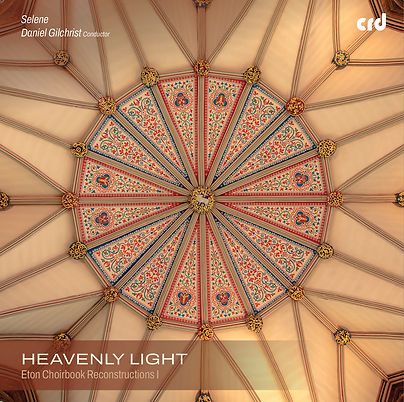
Heavenly Light
CRD3555
The Eton Choirbook is recognised as one of the UK’s national treasures – an extraordinary survival of the religious iconoclasm which swept away so many choral institutions and musical manuscripts as well as a great deal of beautiful art, architecture, sculpture, stone carving, stained glass, and embroidery from the colourful, pre-Reformation world. The Eton Choirbook originally contained ninety-three works by twenty-five composers who hailed variously from Eton, Windsor, Eton’s sister foundation at King’s College, Cambridge, Oxford, and the Royal Court. It was compiled, with great care and no expense spared, and completed around 1504/5. But what makes the Eton Choirbook so special for both listener and performer is that the music it contains is hauntingly beautiful. There really is nothing like it in continental music of the time which the ‘Eton’ works surpass in scale (some last over fifteen minutes), number of voice parts, and use of wide vocal ranges - as well as the high degree of melodic invention and rhythmic complexity which places them beyond the reach of most choirs nowadays. © Russell Blacker